
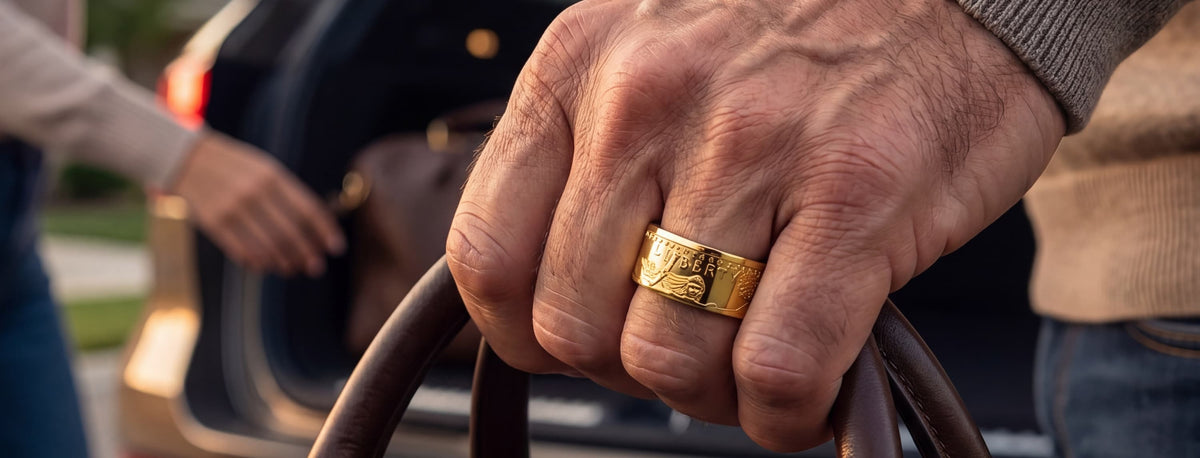
Men's Coin Rings: A Buyer's Guide
What a coin ring actually is, silver or gold, which coin suits you, how to get the size right, and where to start: everything worth knowing before you choose.
Shopping for her? Read the Women’s Buyer’s Guide →
How to Use This Guide
Jump to any section, or read straight through.
What a Coin Ring Actually Is
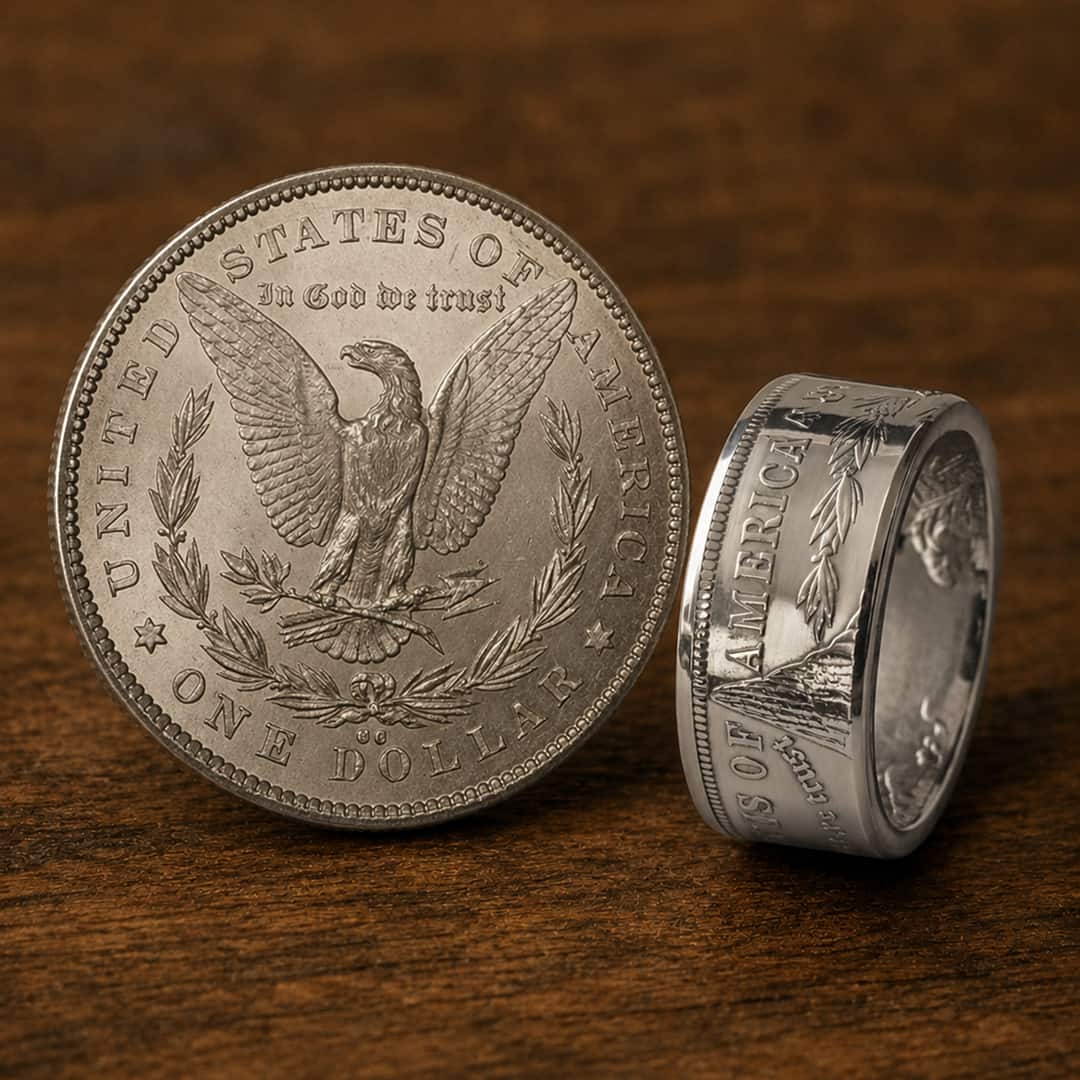
A coin ring begins as a genuine coin. Not a replica, not a coin-shaped blank struck for the jewelry trade — an actual United States coin, struck by the U.S. Mint and issued as legal tender.
Turning that coin into a ring is a hand-forging process: heat and pressure applied a little at a time until the original flat disc becomes a rounded band, sized to be worn. The coin's face and lettering, struck at the mint, carry through onto the finished ring. See the full process, coin to finished ring →
Silver or Gold: Your First Fork
Every coin ring starts with one decision that shapes everything after it:
silver or gold.

Silver
Silver is the wider, more accessible starting point. American silver dollars and silver eagles were struck in the standard 90-99% silver used for U.S. coinage, and a silver coin ring reads as substantial, everyday jewelry — the kind of piece that gets worn without a second thought.

Gold
Gold is a different proposition. Struck from actual gold coinage — full ounces of 22-karat gold, not gold-plated or gold-toned low karat base metals — a gold coin ring carries real weight, literally and as a piece of jewelry. It's a meaningfully larger commitment than silver, and it reads that way on the hand.
Neither is a starter version of the other. They're two different pieces, for two different reasons to want one.
One more angle worth considering: what metals you already wear. If your watch, belt buckle, or everyday hardware leans silver, stainless steel, or brushed nickel, a silver coin ring sits naturally alongside it. If you gravitate toward gold, brass, or warmer-toned metal accents, a gold coin ring reads as part of the same personal style rather than standing apart from it.
How the Coins Differ
Weight, coin, and presence — side by side.
| Morgan Silver Dollar | American Silver Eagle | American Gold Eagle | Pre-1933 Saint-Gaudens | |
|---|---|---|---|---|
| Metal | Silver | Silver | 22-karat gold | 22-karat gold |
| Finished ring weight | 24g | 25g | 26.5g | 26.5g |
| Band width | 10mm | 11.5mm | 9.5mm | 10mm |
| Years minted | 1878–1904 | 1986–present | 1986–present | 1907–1933 |
| Specific-year requests | Possible, but limited | Available (1986–present) | Available (1986–present) | Possible, but limited |
| Presence on hand | Historic & bold | Bold | Bold | Historic & bold |
* Specific-year requests are subject to availability. See how year requests work →
What Quality Should Look Like
Not every coin ring on the market is built the same way, and the difference matters more than it might seem. Seven things to look for that separate a novelty ring from an heirloom.
The coin comes first.
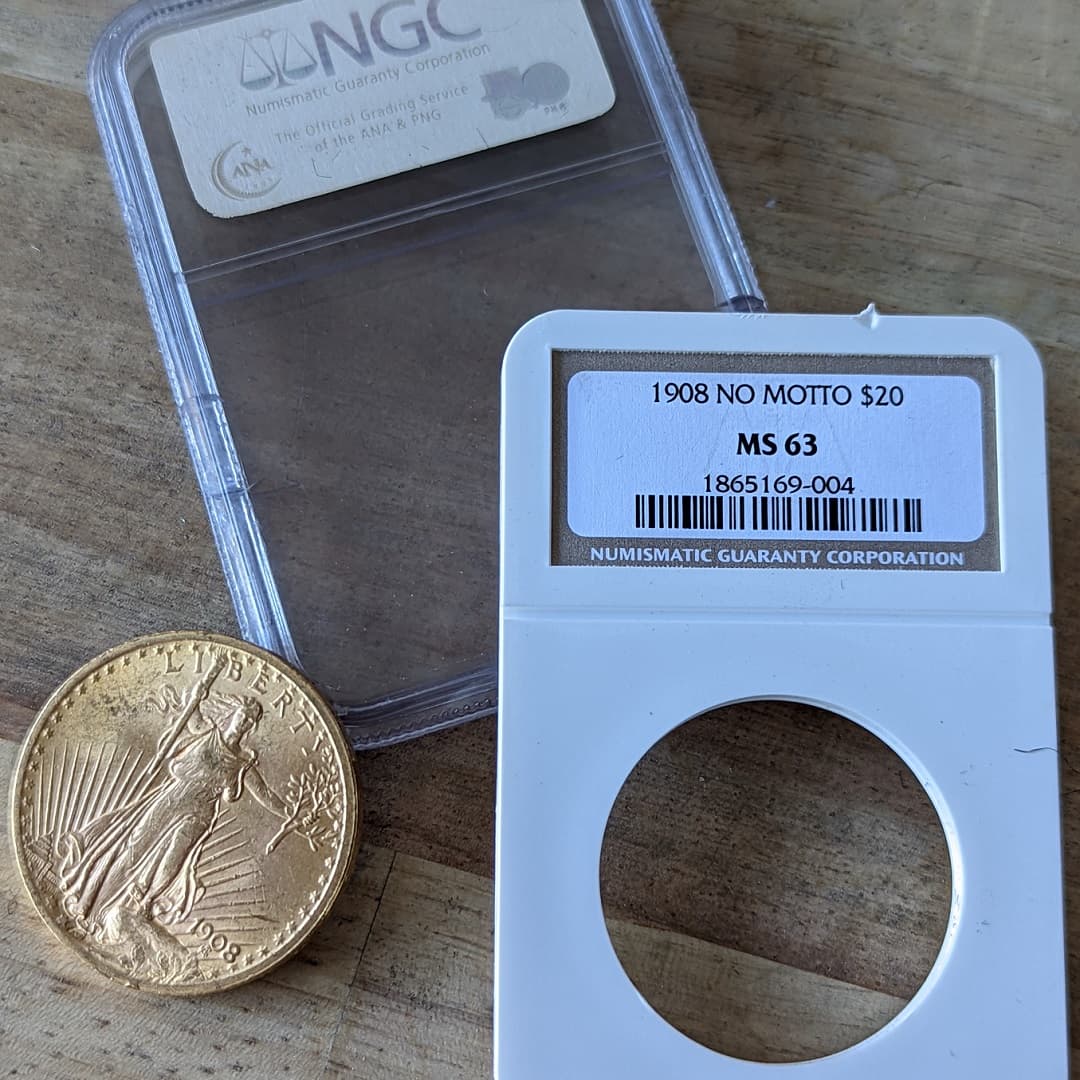
A finished ring can only be as sharp as the coin it started from. Worn or low-grade coins carry soft, indistinct details, dinged edges that catch on clothing, and fields that look dull or uneven no matter how well the forging is done afterward. The standard worth looking for is a coin graded About Uncirculated (AU) or better — ideally Brilliant Uncirculated (BU) or Mint State 63 and above (MS63–65). Below that grade, skill at the bench can't fully make up the difference.
Forged, not cast.
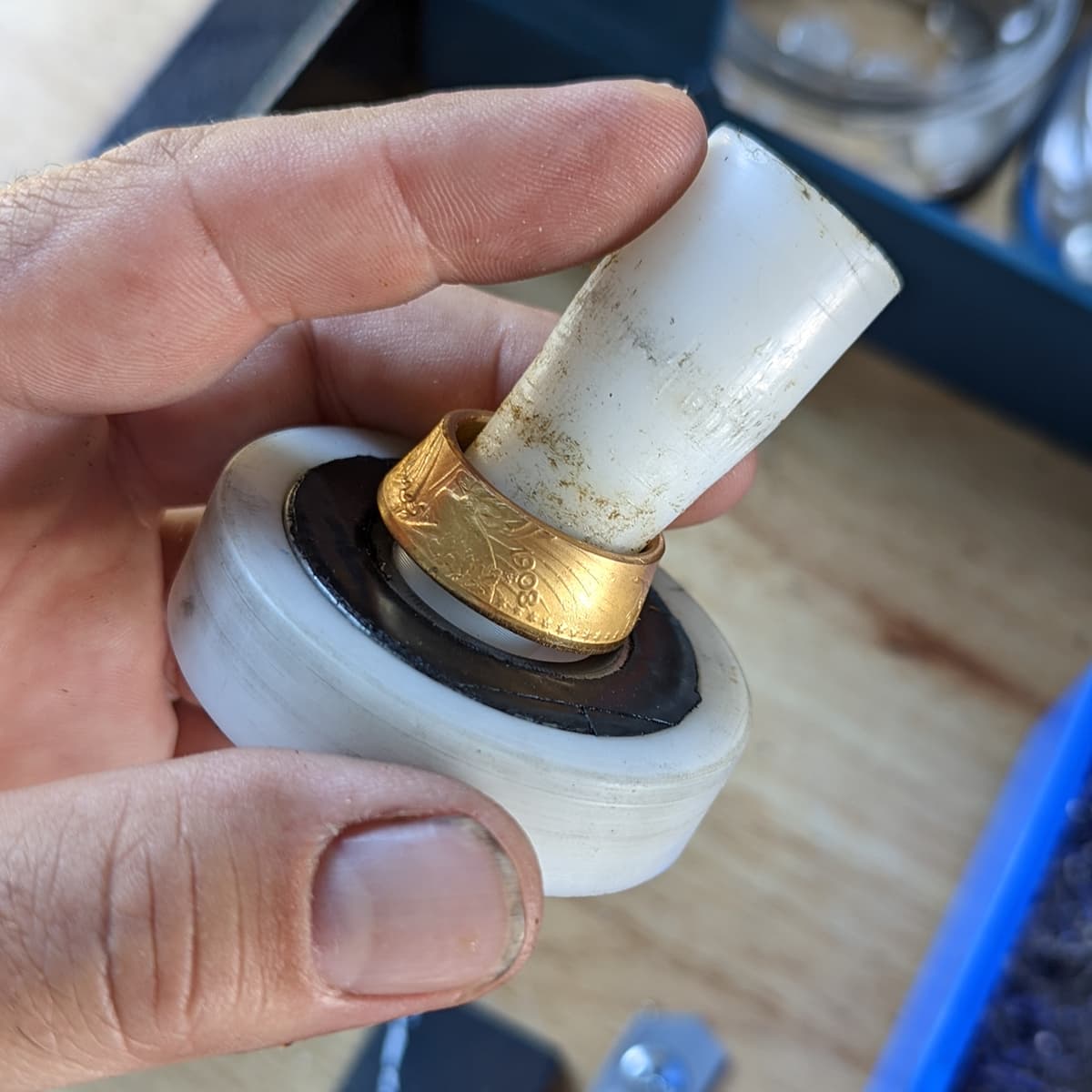
A coin can be reshaped into a ring one of two ways. Casting melts metal into a mold — fast, cheap, and completely erasing the coin's identity.
Forging preserves the actual coin: heat and pressure applied by hand, a little at a time, so the coin's original identity is gradually reshaped from a flat disc into a round ring, and its original details survive the journey.
Perfectly round.
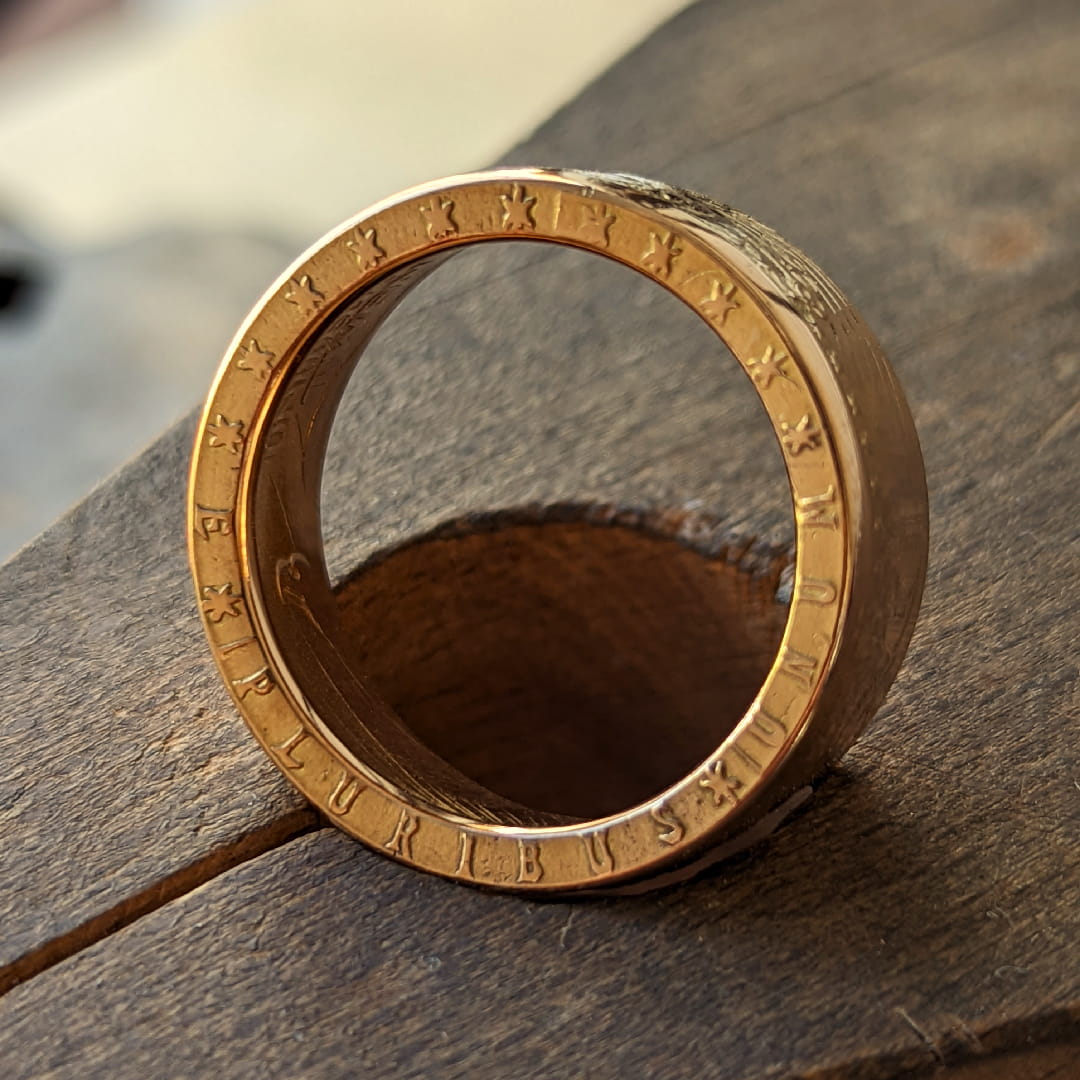
The ring's walls should be arrow-straight, or curve outward with a slight, perfectly smooth convexity. No conical taper, no deviation from true roundness — even a tiny wobble is a sign of a rushed forming process.

Work hardened, not annealed soft.
This one isn't visible on delivery, but it matters most over time. Forging should end while the metal is fully work-hardened. Annealing a ring late in the process is a shortcut that makes it faster and easier to shape, but it leaves the metal soft — and soft metal loses its detail within a month or two of normal wear. There's no way to tell by looking. There's only a difference in how long the detail lasts — months, years, or decades.
Edges finished, details intact.
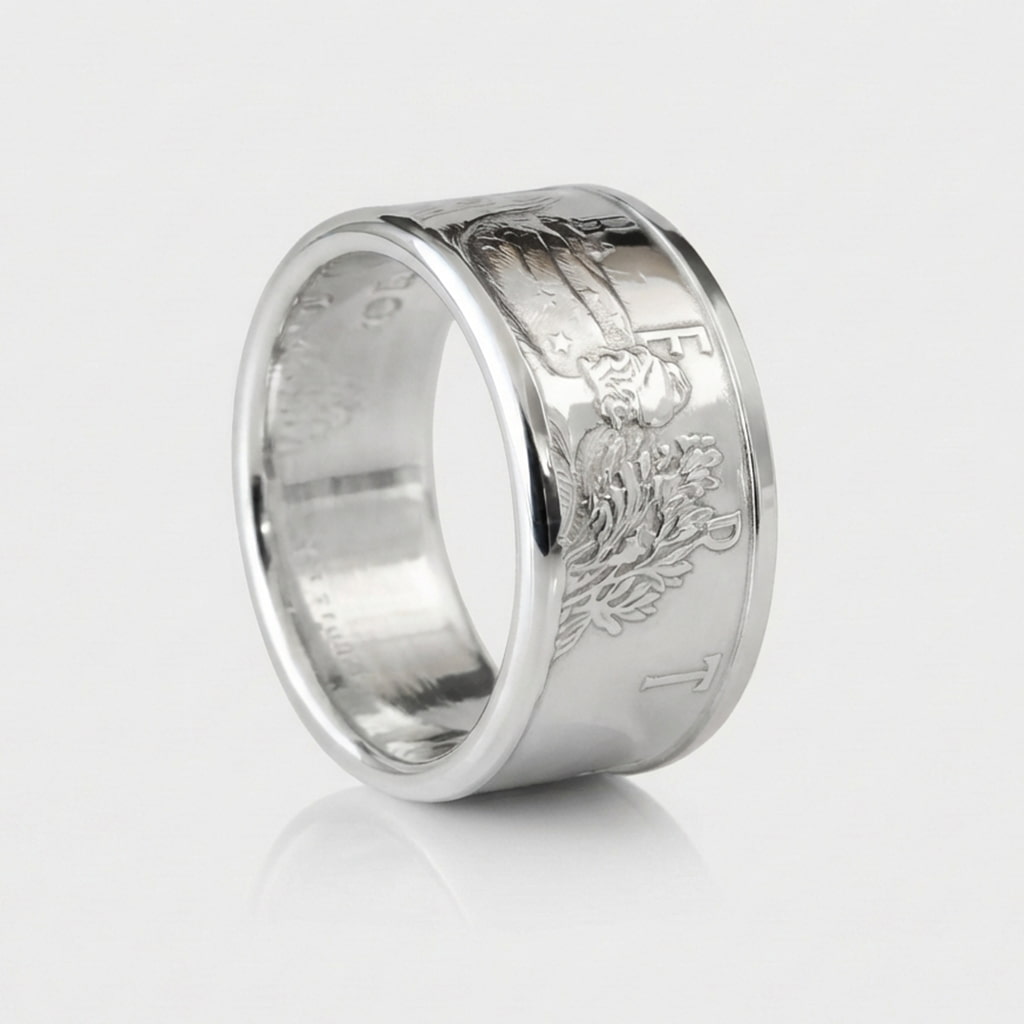
The outer edges should be filed, sanded, and polished — smooth enough to wear comfortably against skin and clothing, without dulling or removing any of the coin's original engraving in the process. Getting all three at once — comfort, beauty and preserved detail — takes real time and skill at the bench.
A true finish.
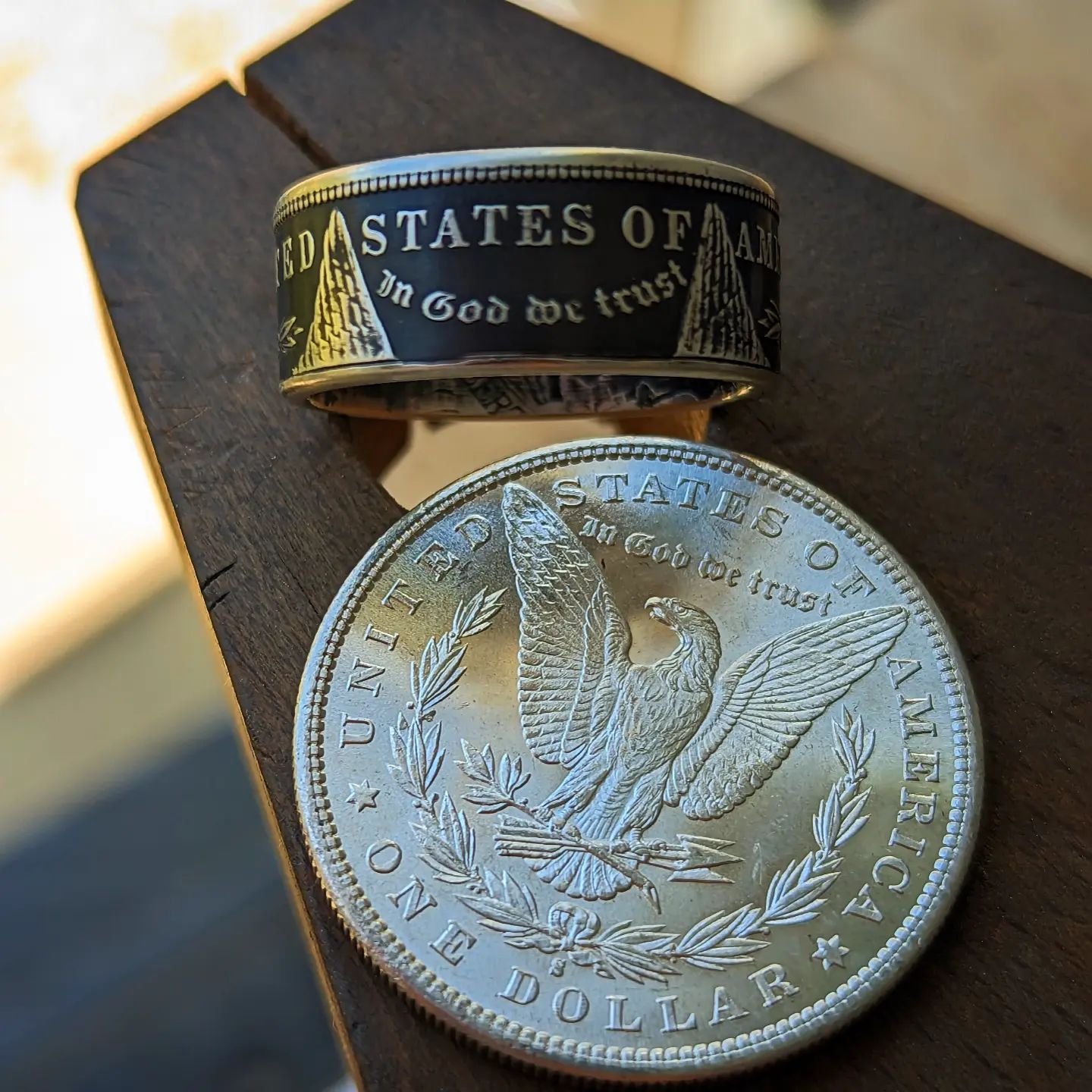
A polished ring should have a genuine mirror finish, not a dull or streaky shine. A patina finish should read as a uniform, dark gray background with the patina lifted cleanly from the raised details, so the bright metal underneath shows through the engraving without disturbing it.

Naturally hypoallergenic.
Genuine sovereign silver and gold coins don't contain nickel or the other base metals that cause skin irritation and discoloration in cheaper jewelry-alloy pieces — including a lot of what's sold as novelty or hobbyist coin jewelry. Worth knowing if rings have ever bothered your skin before.
Coin rings that meet all seven of these are a smaller, more specific category than "coin rings" as a whole.
Getting the Size Right
Not sure what size you wear? You're not the only one — plenty of men haven't bought a ring for themselves in years, if ever, and confirming a size before ordering is one of the most common questions we get.
One myth worth clearing up: a coin ring doesn't need to be ordered a half or full size larger than normal, the way it sometimes does with traditional wider band rings.
True to size is still the right call.
Three Options:
Measured by a Jeweler
Have your size measured professionally by a local jeweler. Usually fast and free.
Request A Sizer With Your Order
Choose "Request Ring Sizer" instead of specifying a size when you order. We'll mail you a sizing tool - no additional cost. Then email us your size, we'll finish and ship your ring.
Purchase a Sizer Before Ordering
Order a ring sizer directly from us, measure your finger at home, and then place your ring order.
A local jeweler can measure your size, but if resizing is ever necessary, it should be done by the maker, not a local jeweler. Full detail, including how to size for a gift, is in the Sizing Protocol.

Living With It
A quality coin ring is forged from metal struck to a national minting standard: dense, durable, real silver or gold. Day to day, it needs almost nothing — no polishing schedule, no special storage. These rings are durable and meant to be worn.
That said, no silver or gold jewelry — ours or anyone else's — holds up indefinitely against repeated impact against other hard surfaces. If your day involves hand tools, workshop equipment, or heavy lifting, take it off first. Same goes for the gym. It's common sense that applies to any fine jewelry, not something unique to coin rings.
Refinishing and resizing, if they're ever needed, should always be fast and free, for life. No one likes getting nickel-and-dimed, and total cost of ownership should never rise over time.
The Four Starting Points
Four proven starting points. Each is built to the same standard — the difference is which one fits how you want to wear it.
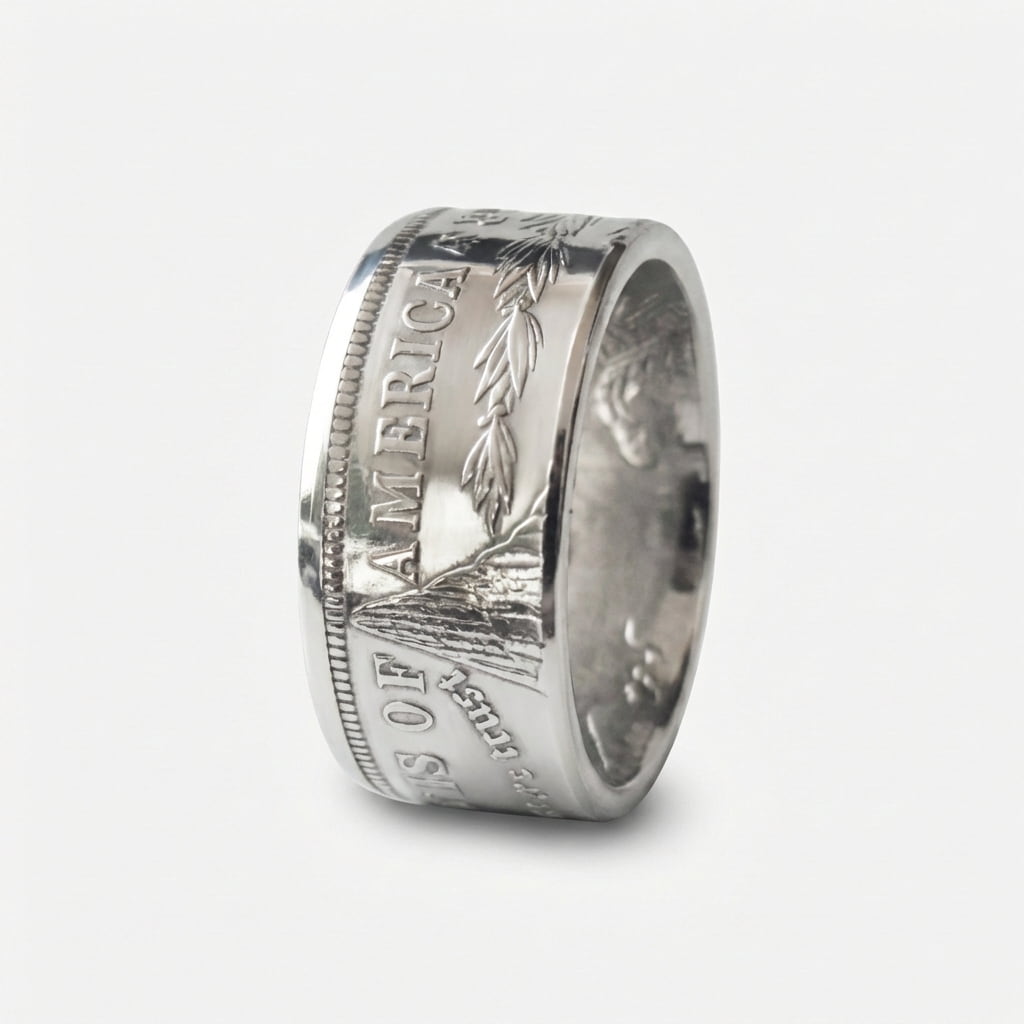
Heritage Silver
Morgan Silver Dollar
The classic choice, carrying the deepest history: struck 1878–1904, from Comstock Lode silver, in circulation through the era of saloons, mining camps, and railroad payrolls. Right for the buyer for whom the history is the whole point.
495
Heritage Silver
American Silver Eagle
The modern standard-bearer, and the widest band of the four — the boldest presence in silver. Features Lady Liberty from the original 1917 Walking Liberty Half Dollar design. Right for the buyer who wants maximum impact without moving into gold.
525
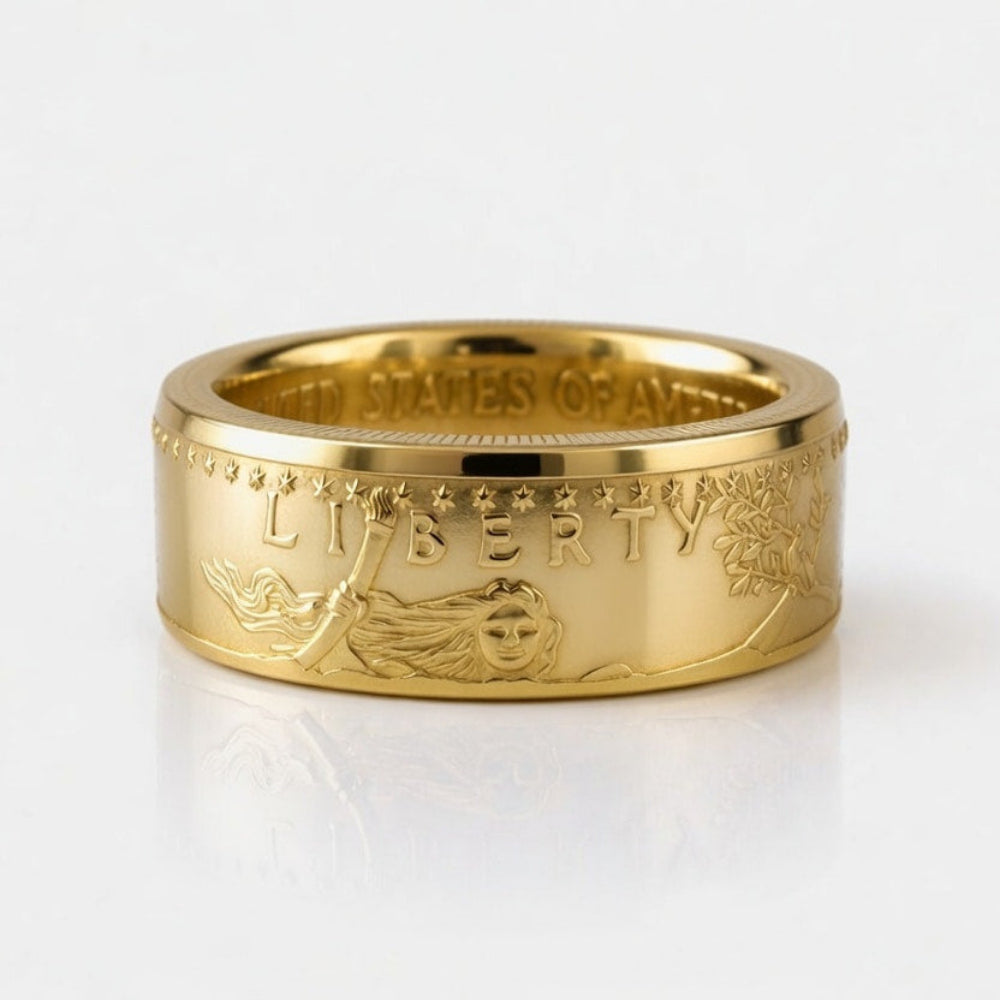
Sovereign Gold
American Gold Eagle
Forged from a full one-ounce, 22-karat gold coin. The finished ring is a solid, heavy, masculine piece — true gold weight, not a diluted alloy dressed up to look like it. Right for the buyer who wants real gold presence, not low-karat gold-tone jewelry.
5750
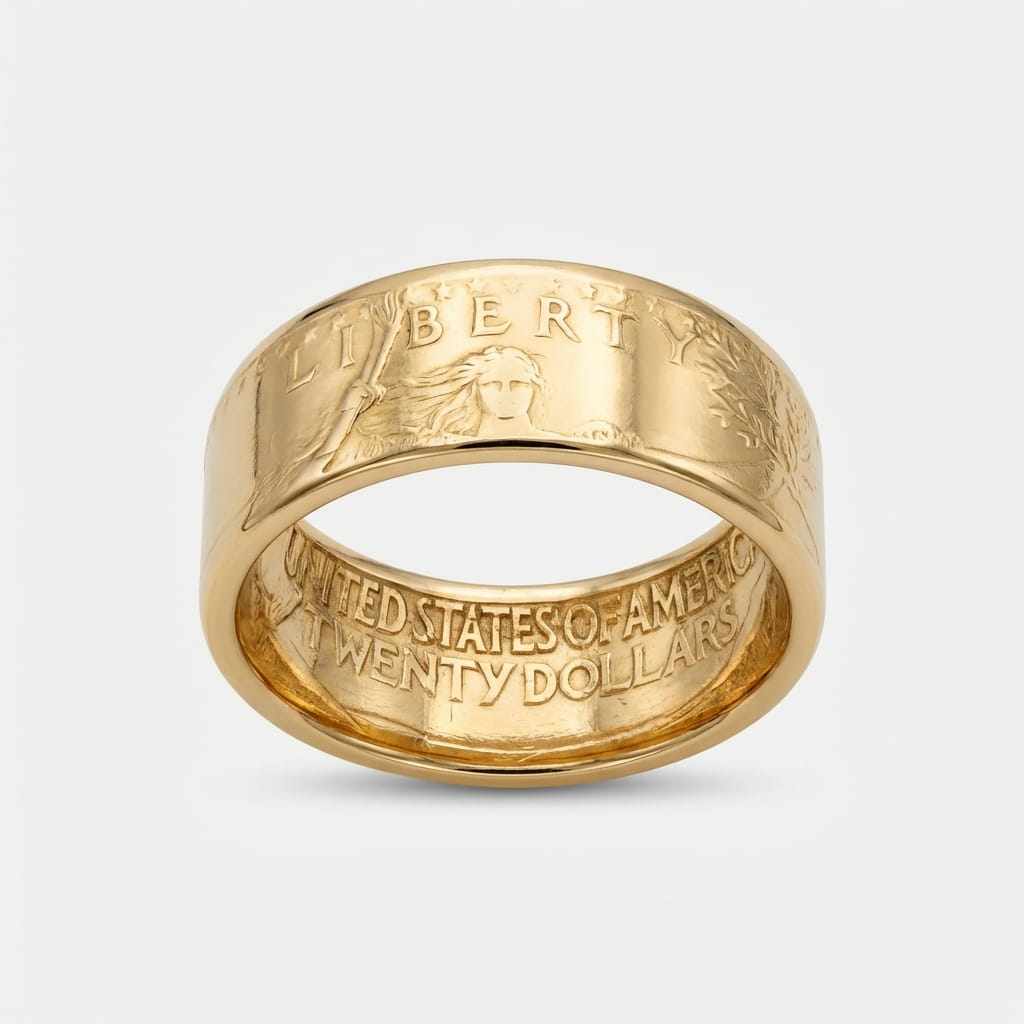
Sovereign Gold
Reserve Edition Pre-33 Saint-Gaudens Gold
Struck before 1933, when gold coinage still circulated as everyday money. A stamped edge and a deeper tone mark it as older. Right for the buyer for whom rarity and pre-1933 history matter more than the current standard design.
7450
Beyond the Four
Smaller frame, a gift, or a coin of your own? A few other paths.
-
 Walking Liberty Half Dollar
Smaller diameter — a common choice for medium and smaller hands.
-
 Half-Ounce Gold Eagle
The lighter gold option — same 22-karat coin, a more refined presence.
-
 Morgan Money Clip
An everyday carry item unlike any you've ever seen before. Money holding money.
-
 Legacy Chamber
Specialty inlays, memorial rings and personalized pieces beyond the standard four.
-
 Provide Your Own Coin
Already have a coin with meaning attached? It can be forged into a ring instead of using one of our coins.
-
 Union Chamber
Coin ring wedding sets, paired or solo.


Arrives by December 23
Holiday Delivery
Every piece is made to order, so these dates include time at the bench. All cutoffs are 11:59 pm Eastern.
Specific-year requests
Gold and Silver Eagles from a requested year
Order by
Friday, December 11
11:59 pm ET
Specific years take extra time to source, so these close first.
All other pieces
Rings, earrings and pendants
Order by
Tuesday, December 15
11:59 pm ET
Standard free shipping: Next Day on gold, Priority on silver.
Last chance
Next Day shipping
Order by
Friday, December 18
11:59 pm ET
Gold already ships Next Day at no charge. Silver needs the Next Day shipping upgrade ($65) at checkout. Specific-year requests aren’t eligible.
Gold always ships free by Next Day UPS or FedEx. Silver ships free by Priority, usually 2–3 day service. Every package is tracked and insured, and every order placed by these dates arrives by December 23.
Still Deciding?
Browse the full collections, or reach out through Private Concierge with any question this guide didn't answer.